HS-3D-NeRF: NeRF-based Point Cloud Reconstruction using a Stationary Camera for Agricultural Applications

Iowa State University
HS-3D-NeRF

Abstract

Advances in hyperspectral imaging (HSI) and 3D reconstruction methods have enabled accurate and high-throughput characterization of agricultural produce quality and plant phenotypes, both of which are essential for advancing agricultural sustainability and enhancing breeding programs. HSI effectively captures detailed biochemical features of produce, while 3D geometric data significantly improves morphological analysis. However, integrating these two modalities at scale poses significant challenges. Conventional 3D reconstruction techniques often involve complex hardware setups that are difficult to integrate into automated phenotyping systems. Recent advances in neural radiance fields (NeRF) offer computationally efficient 3D reconstruction but typically require moving-camera setups, which limit throughput and reproducibility in standard indoor agricultural phenotyping environments. To address these challenges, we introduce a stationary-camera-based multi-channel NeRF framework designed explicitly for high-throughput hyperspectral reconstruction for postharvest inspection of agricultural produce. Our method captures multi-view hyperspectral data using a stationary hyperspectral camera by rotating the object in front of a carefully calibrated dark screen. We then estimate the relative pose of the rotated object with the help of calibration markers. These poses are then transformed to the camera frame of reference using simulated pose transformations, which facilitate NeRF training using standard approaches. In addition, we convert traditional 3-channel NeRF to use the multiple channels of the hyperspectral data to calculate the loss. Our approach yield high-resolution 3D hyperspectral point clouds with high precision-recall scores. Our results demonstrate that stationary-camera NeRF enables robust 3D hyperspectral reconstruction into automated agricultural workflows.
Methodology

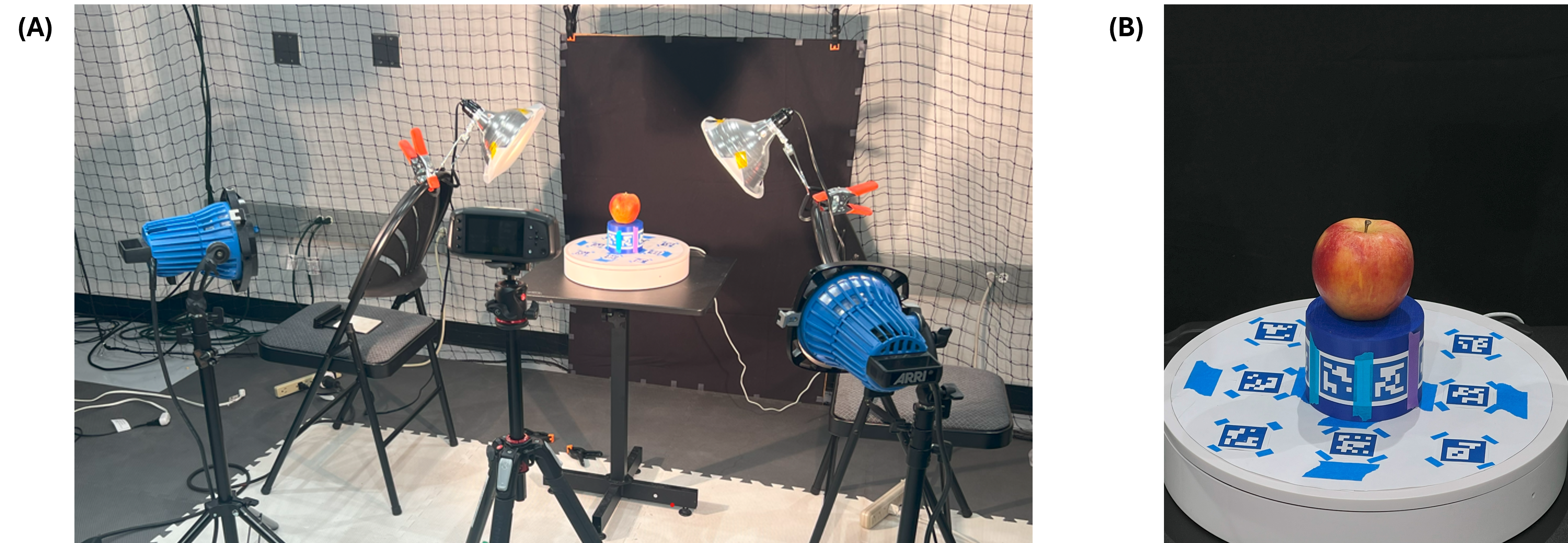
experimenta_setup

Experimental setup: (A) Overall setup, where a stationary hyperspectral camera (SPECIM IQ) records a rotating object (green bell pepper) placed on a turntable against a black matte fabric to minimize background noise and improve segmentation. (B) Close-up of the turntable and object, highlighting the elevated platform and ArUco markers used for pose estimation and structured scene reconstruction.

Workflow

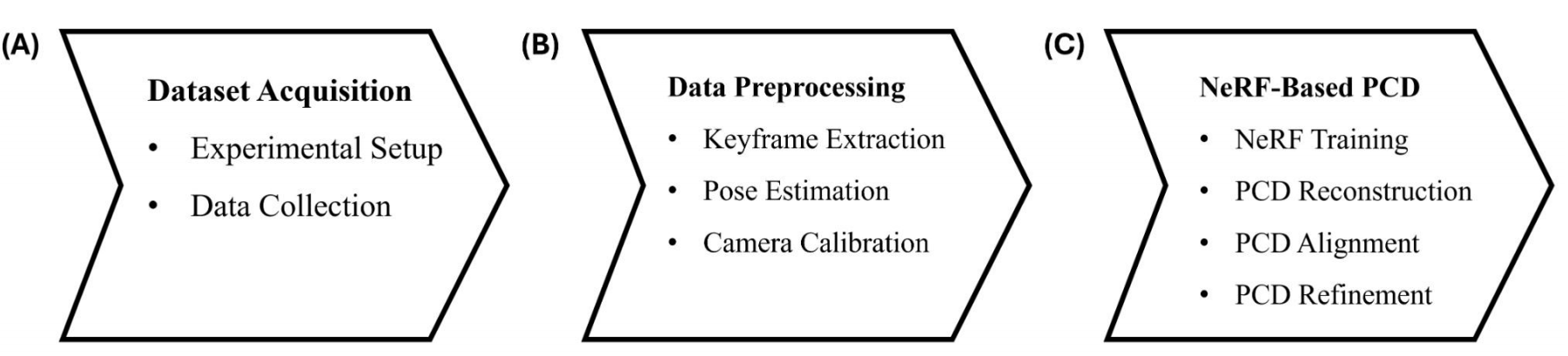
Workflow of the NeRF-based 3D reconstruction pipeline. The process consists of three main steps: (A) Dataset Acquisition, where the experimental environment is set up, and multi-view image data is collected using a stationary camera; (B) Data Preprocessing, involving Keyframe extraction, pose estimation, and camera calibration to ensure geometric consistency; and (C) NeRF-Based PCD, where a NeRF model is trained for scene representation, followed by PCD Reconstruction, Alignment, and Refinement to generate high-quality 3D point clouds. This structured approach improves the accuracy and scalability of 3D reconstruction for phenotyping and other agricultural vision applications.

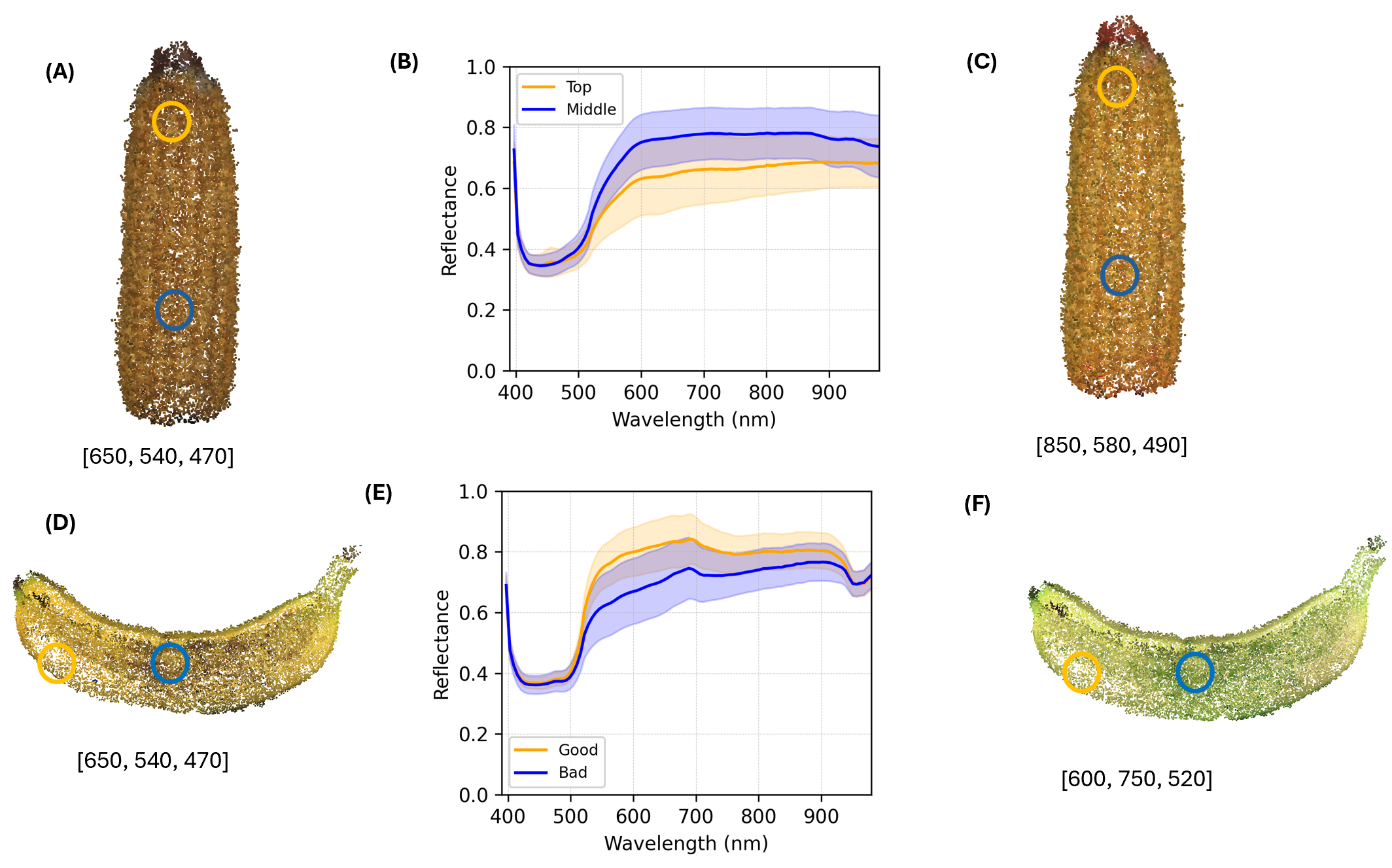
Samples from the Dataset

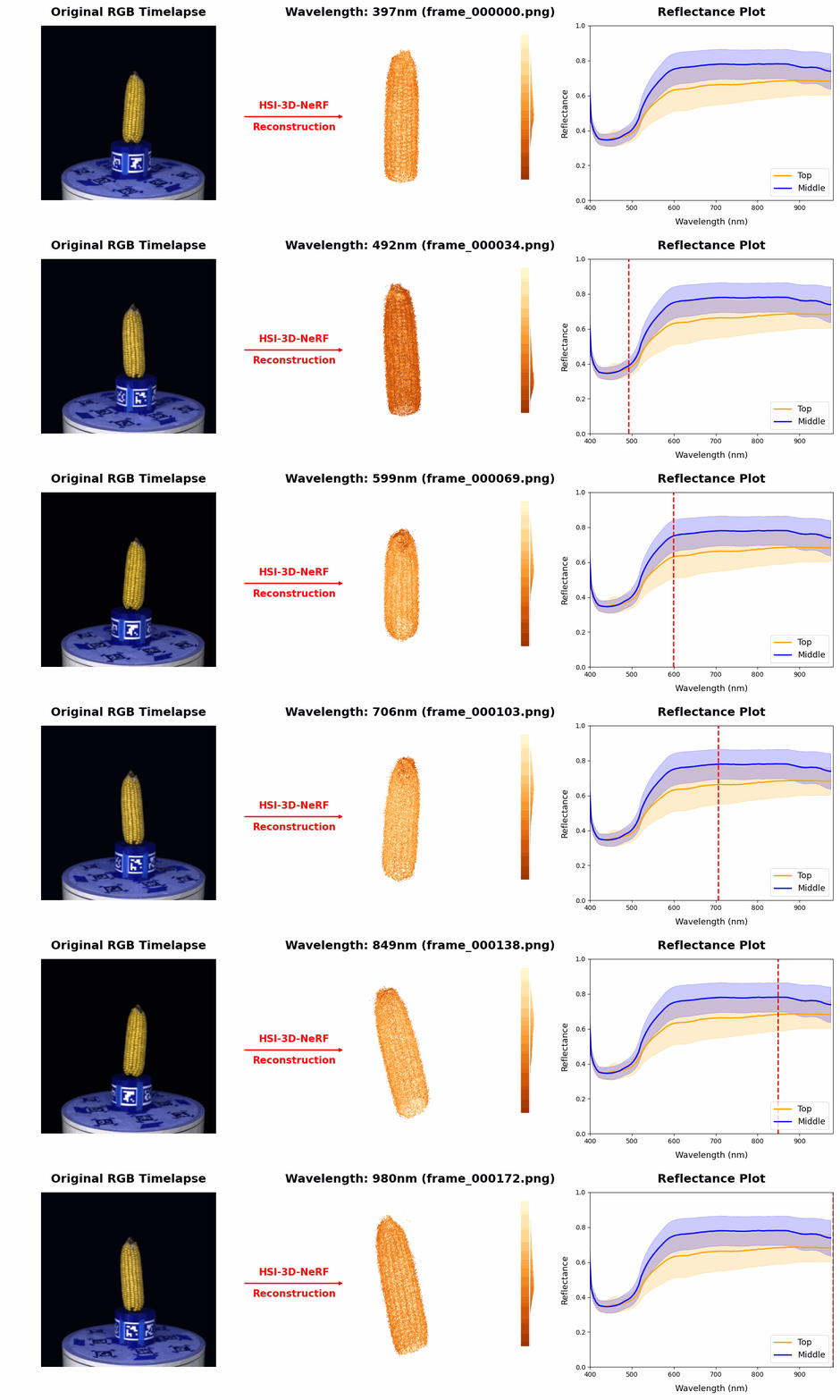
spectral_signature

Acknowledgements

This work was supported by the AI Research Institutes program [AI Institute: for Resilient Agriculture (AIIRA), Award No.2021-67021-35329]from the National Science Foundation and U.S. Department of Agriculture’s National Institute of Food and Agriculture.

Team

BibTeX

@inproceedings{kibon2025nerf,
  title={HS-3D-NeRF: 3D Surface and Hyperspectral Reconstruction From Stationary Hyperspectral Images Using Multi-Channel NeRFs}, 
  author={Kibon Ku,
    Talukder Z Jubery,
    Adarsh Krishnamurthy,
    Baskar Ganapathysubramanian}
  booktitle={Arxiv},
  year={2025},
  primaryClass={cs.CV},
  url={}
}